




After reading the article “Tuan di Rumah Sendiri” written by Ahmadie Thaha, a senior journalist at the daily Republika during its print era, who frequently contributed opinion pieces to this renowned national newspaper, a pivotal question arises: how can this be achieved?
This “How to” question serves as an essential bridge linking abstract thoughts with tangible actions. Upon brief reflection, the answer emerges: Pesantren Management.
Ahmadi distilled insights from the newly appointed Minister of Religious Affairs, Prof. Dr. KH. Nasaruddin Umar, who previously served as the Grand Imam of Istiqlal Mosque. In his speech, the Minister emphasized that pesantren, as the oldest educational institutions in Nusantara, represent a bastion of civilization that integrates religious and general knowledge within a single spiritual breath.
Before the colonial era, pesantren already served as centers of education, da’wah, and societal transformation. However, over time, pesantren have often been perceived as alternative educational institutions, overshadowed by the “formal” standards established by Western norms. This presents a significant challenge for pesantren to effectively manage themselves, maintain their identity, and remain adaptable and relevant in the modern era.
One of the efforts to achieve this is through building awareness of pesantren management, developing a living system that integrates Islamic values into every managerial level. This becomes key to ensuring that the educational system remains true to its traditional roots while responding to contemporary challenges.
In this context, pesantren management is not merely about structuring and formulating policies; it also involves ensuring that every policy is rooted in Islamic values, etiquette, and noble character. Managerial duties in pesantren are acts of worship, and every decision must be guided by sincere intentions and aimed at the welfare of the community.
To this day and in the future, pesantren hold immense potential to become centers of educational excellence rooted in Islamic values. This is inseparable from their guiding principle of preserving values and striving for perfection, often expressed in pesantren mottos: “المحافظة على القيم والتغيير إلى الكمال” (preserving values while evolving towards perfection).
To realize this vision, pesantren must manage their resources effectively, from curriculum development to financial management, and establish networks with various stakeholders. This is the spirit that Ahmadie Thaha seeks to build: pesantren must have the courage to be “masters in their own home,” strategically positioning themselves within the national educational landscape by highlighting their unique and distinctive systems.
Pesantren management must be founded on the principle that knowledge is a trust from Allah SWT. Therefore, managing pesantren cannot be entirely equated with other educational institutions. The primary focus is cultivating sincerity and blessings in every educational activity. The Qur’an, as Kalamullah (the Speech of Allah), should be the source of inspiration in policy-making and guiding students to deeply understand religious teachings, not merely as rote memorization or written texts.
A spiritual approach in management also implies that every leader and teacher in pesantren serves as a mursyid, providing guidance not only in academic aspects but also in character development. This involves a personal approach, strict supervision, and a dialogue between teachers and students that goes beyond formal curriculum boundaries.
Thus, in preserving the quality of pesantren education, the applied approach must not sacrifice the spirituality that forms its core. Quality assurance in pesantren should be based on Islamic values, distinct from the pragmatic and rational standards of general education. This requires pesantren to build a quality control system based on their unique characteristics, while still considering relevance to modern demands.
The government has taken steps to establish the Directorate General of Pesantren as a body to support pesantren throughout Indonesia. This is a strategic move that is expected to provide protection and reinforcement for pesantren. However, beyond that, strengthening managerial knowledge, particularly in pesantren management, becomes an urgent need.
Therefore, in addition to forming the Directorate General of Pesantren, the government should issue regulations and grant licenses for establishing “Pesantren Management” study programs aimed at producing competent pesantren managers as part of becoming masters in their own home.
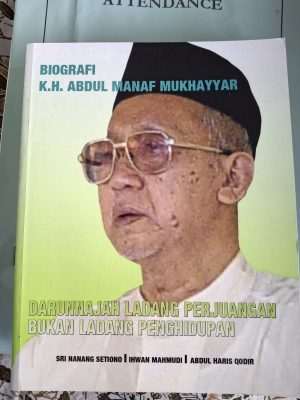
Such a study program could serve as a strategic effort to develop superior human resources and bridge pesantren to the international arena. Certain pesantren, such as Gontor and Darunnajah, have already proven their ability to integrate their values with a global perspective, making them sought-after destinations for study tours by Muslim communities worldwide.
Ultimately, it is crucial to hold onto the belief that good pesantren management is one that can balance Islamic values with modern innovations, grounded in sincerity, noble character, and a spirit of building civilization. In doing so, pesantren can truly become “masters in their own home” and once again take their rightful place as a central force in education in Indonesia and beyond.
May this article inspire pesantren leaders across the archipelago to continuously innovate and contribute to building a generation of outstanding and morally upright citizens. Salam.
Muhammad Irfanudin Kurniawan
Lecturer at Darunnajah University
Email: irfanudinnk@darunnajah.ac.id