




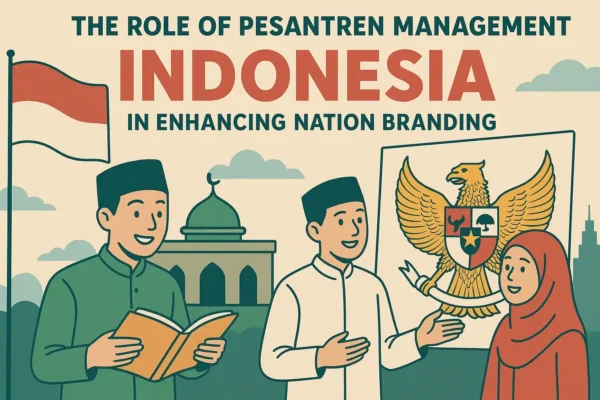
Pesantren has long been one of Indonesia’s most distinctive educational institutions, shaping not only religious understanding but also the character and mindset of its students. In today’s global era, pesantren is increasingly recognized as a cultural asset that strengthens Indonesia’s identity on the world stage. The way pesantren are managed, developed, and communicated now plays a crucial role in supporting Indonesia’s nation branding.
Good pesantren management reflects the Quranic principles of excellence and order, as stated in QS. Al-Mulk: 2, which reminds believers to strive for “the best in deeds.” This encourages pesantren leaders to adopt professional and modern management practices while maintaining authentic Islamic values—scholars such as KH. Abdurrahman Wahid (Gus Dur) often emphasized that pesantren must evolve while preserving their soul, becoming locally rooted yet globally respected institutions.
In recent years, pesantren have expanded their international engagement through student exchanges, research cooperation, and cultural diplomacy. These initiatives strengthen Indonesia’s soft power—the ability to influence global audiences through culture and values rather than force. Joseph Nye, who introduced the concept of soft power, notes that countries with inspiring educational and cultural institutions tend to have strong global influence. Pesantren, with its blend of spirituality, discipline, and intellectual tradition, makes a significant contribution to this narrative.
Effective pesantren management also shapes graduates who naturally become cultural ambassadors abroad. Many alumni work in international NGOs, global education, and multicultural communities, carrying with them the pesantren ethos of humility and service. The Prophet Muhammad ﷺ said, “The best of people are those who are most beneficial to others” (HR. Ahmad). When pesantren graduates bring these values to the world, they enhance Indonesia’s image as a nation of compassion and wisdom.
This is where the Islamic Education Management Study Program, Universitas Darunnajah, plays a strategic role. As a program that combines pesantren heritage with modern educational management, it equips students with the skills to manage Islamic institutions professionally—leadership, governance, quality assurance, public communication, and international engagement. Graduates of this program are prepared not only to strengthen pesantren operations but also to elevate their branding, digital presence, and global collaborations, directly supporting Indonesia’s nation branding efforts.
Digital transformation further expands these opportunities. Today’s audiences connect through social media, storytelling, and online dialogue, making digital literacy essential for pesantren. With support from students and graduates of the Islamic Education Management Study Program, pesantren can produce compelling digital content, conduct international webinars, and communicate their values more effectively. Contemporary scholar Tariq Ramadan stresses that Muslims must use modern tools to share Islamic values confidently, and this aligns perfectly with what pesantren and the program aim to achieve.
Ultimately, the synergy between pesantren and higher education—especially the Islamic Education Management Study Program, Universitas Darunnajah—creates a stronger foundation for Indonesia’s nation branding. When pesantren are managed with excellence, supported by academically trained professionals, and connected to global platforms, they reinforce Indonesia’s reputation as a center of moderate, progressive Islamic education. This shows that nation branding is not only shaped by government institutions but also by campuses, pesantren, and the leaders emerging from them.