




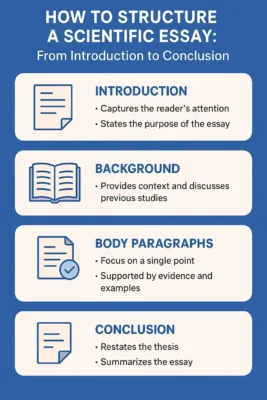
Writing a scientific essay is not only about presenting information but also about organizing ideas in a logical and persuasive manner. An effectively structured essay presents arguments in a coherent flow and sustains the reader’s focus from beginning to end.
The introduction serves as the entry point, aiming to draw the reader’s attention and clearly outline the essay’s purpose. A good introduction also provides a concise overview of the topic and states the main argument or thesis statement.
Following the introduction is the background or literature review section, where you provide context for your research. In this section, you examine prior studies, identify unresolved issues, and highlight the significance of your essay’s contribution.
The body paragraphs form the core of a scientific essay, where evidence and analysis are developed. Each paragraph should focus on a single point, supported by credible data, logical reasoning, and relevant examples.
Transitions between paragraphs are crucial to maintaining the flow of ideas. Smooth connections help the reader understand how each point relates to the overall argument, ensuring coherence throughout the essay.
The discussion section is where you interpret your findings and connect them back to the thesis. This section allows you to demonstrate critical thinking by evaluating the significance of the evidence and acknowledging any limitations.
In the conclusion, all points are brought together by reaffirming the thesis in light of the arguments presented. A strong conclusion not only summarizes the main points but also reinforces the importance of the essay for the reader.
Overall, structuring a scientific essay depends on clarity, precision, and logical development. By carefully crafting each section—from the introduction to the conclusion—you ensure that your work communicates both authority and professionalism.
writer: Winda Rahma Juwita